A Film Extrusion Machine is an industrial system that converts plastic resin into a continuous, thin film. It uses controlled heat, pressure, and cooling. The process begins with small resin pellets. These pellets enter a heated barrel through a feed hopper. A rotating screw then melts and mixes the material. The molten plastic moves toward a flat die or circular die. From there, it becomes a sheet or tube.
The details matter. Temperature settings influence melt strength and clarity. Screw speed affects output and mixing. Airflow, cooling, and winding tension shape the final film. A small temperature change can create wrinkles, uneven thickness, or weak edges. Dr. Chris Rauwendaal, a respected polymer extrusion authority, states, “The goal of extrusion is to produce a product with the desired dimensions and properties at the lowest possible cost.” That principle remains practical on a factory floor.
Not every Film Extrusion Machine performs identically. Resin grade, moisture, die design, and operator experience can change results. A modern machine may include automatic gauge control, gravimetric feeding, and online thickness measurement. These features improve stability, but they cannot replace careful process judgment. The first film roll may still reveal unexpected variation. That is normal. Engineers often adjust temperatures, cooling conditions, and tension after reviewing actual film data. A clear understanding of the machine helps manufacturers choose equipment wisely, reduce material waste, and maintain reliable production. Yet, any simple explanation has limits. Real performance depends on maintenance, calibration, and the specific film application.
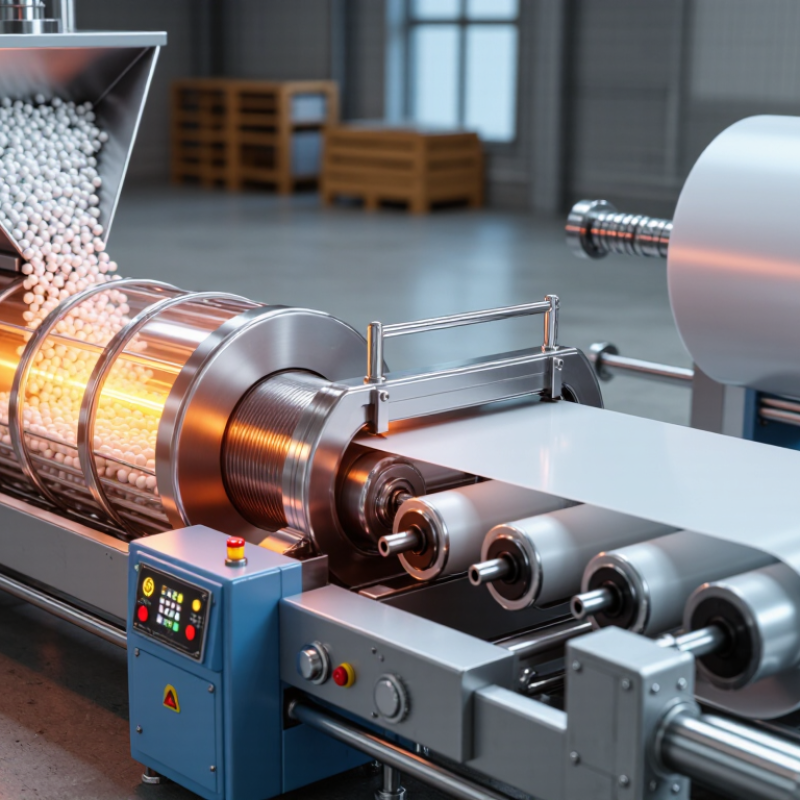
A film extrusion machine converts plastic resin pellets into continuous, thin film. Heat softens the resin inside a barrel. A rotating screw then pushes the melted material toward a shaping die. The die forms the film into a tube or flat sheet. Cooling air or chilled rollers quickly stabilize its thickness. Haul-off rollers control movement, while a winding unit collects the finished film. The system may include thickness controls, temperature sensors, and edge-trimming equipment. It is a coordinated process, not simply a heating machine.
Its main purpose is to produce consistent film for packaging, agriculture, construction, and industrial protection. Film quality depends on resin condition, temperature balance, screw speed, air flow, and winding tension. A small temperature drift can create cloudy areas or uneven thickness. Excessive tension may stretch the film and weaken its edges. Experienced operators check the surface, roll shape, and thickness during production. Some settings look correct but still produce unstable results. That part deserves reflection.
Tips: Dry moisture-sensitive resin before processing. Check the die for residue and wear. Measure film thickness across the roll, not only at the center. Keep cooling air steady. Record changes in temperature, speed, and tension. Small adjustments are safer than sudden corrections.
A film extrusion machine converts plastic resin into a continuous, thin film. Small resin pellets enter through the hopper and fall into a heated barrel. Inside, a rotating screw conveys, melts, and mixes the material. Its flights create pressure while controlling the melt flow. Temperature zones must remain stable. Uneven heating can create weak spots or cloudy areas.
The die shapes the melted plastic into a tube or flat sheet. In blown film production, air inflates the tube inside the die. Cooling rings then direct air around the hot film, setting its thickness and appearance. A flat-film line uses a chill roll instead. This polished metal roll cools the melt quickly and supports a smoother surface.
After cooling, guide rollers pull the film at a controlled speed. Thickness sensors can detect variation across the web. The haul-off unit maintains tension, while the winder forms a neat roll for later processing. Control systems coordinate temperature, speed, pressure, and cooling air. Operators still need practical judgment. A stable reading does not always mean a perfect film. Dust, moisture, or slight screw wear may remain hidden during a short run. Experienced technicians inspect the edges, listen for unusual vibration, and adjust gradually. Small changes often protect film quality better than sudden corrections.
What Is a Film Extrusion Machine?
How the Film Extrusion Process Works
A film extrusion machine converts plastic resin into thin, continuous film. Small resin pellets enter a heated barrel through a feed hopper. A rotating screw carries them forward while heat and friction soften the material. The screw also mixes the melt and pushes it toward a narrow die. Temperature must remain stable. Even a small variation can change film thickness.
At the die, molten plastic leaves as a flat sheet or a circular tube. Flat-film lines use a wide slit die and cooling rollers. Blown-film lines form a bubble with controlled air pressure. The bubble rises, cools, and collapses between rollers. This stage demands careful adjustment. Airflow, haul-off speed, and melt temperature affect clarity, strength, and width.
The cooled film then passes through measuring and winding equipment. Sensors can detect thickness changes across the web. Operators may adjust screw speed, die gaps, or cooling conditions. Good settings reduce wrinkles and uneven edges. Still, the process is not perfectly uniform. Resin moisture, room temperature, and minor die contamination can create defects. Experienced technicians inspect the film directly, not only through digital readings. A sample may look acceptable at one point, then reveal weak sealing later. That is why production checks should include thickness, appearance, tensile behavior, and sealing performance.
A film extrusion machine melts polymer resin, pushes it through a die, and forms the material into a continuous film. The chart shows indicative barrel and die temperature ranges commonly used for polyethylene film extrusion. Actual settings vary according to resin grade, film thickness, additives, and equipment design.
A film extrusion machine converts plastic resin into thin, continuous film for packaging, agriculture, construction, and industrial applications. The machine melts measured resin, pushes it through a die, and cools the film under controlled conditions. In practical operation, temperature stability matters as much as output speed. Small thermal changes can create wrinkles, weak edges, or uneven thickness.
Blown film extrusion machines form a circular tube through an annular die. Air inflates the hot tube, while cooling rings help set its shape before collapsing rollers flatten it. This design suits bags, liners, and flexible packaging films.
Cast film extrusion machines push molten plastic through a flat die onto a chilled roller. They usually provide clearer film, tighter thickness control, and faster cooling. Operators often inspect the film surface under strong lighting.
Multilayer coextrusion machines combine two or more materials in one film structure. Each layer can provide strength, sealing performance, moisture resistance, or visual appeal. Some systems use three layers, while advanced production lines use more. The correct choice depends on resin behavior, film width, gauge, cooling capacity, and required production volume. A higher layer count does not automatically improve performance. No machine is perfect. Poor material drying, inaccurate settings, or neglected rollers can reduce quality quickly. Real production trials remain essential, because laboratory assumptions may not match factory conditions.
A film extrusion machine melts polymer pellets and forms them into a continuous plastic film. The process usually includes feeding, heating, die forming, cooling, and winding. Film thickness may range from very thin wrapping material to heavier industrial sheets.
Key applications include food packaging, agricultural covers, construction membranes, medical packaging, and protective liners. Each use demands different performance. Packaging may require clarity and sealing strength. Agricultural film needs flexibility, tear resistance, and protection from sunlight. Industrial film often needs higher puncture resistance. Additives can improve these properties, but they also affect processing stability.
Selection should begin with the required film width, thickness range, material type, and target output. Do not choose by output alone. A larger machine may waste energy when production volumes are modest. Screw design, die control, cooling capacity, and winding accuracy also matter. For multilayer film, layer uniformity becomes critical. Operators should examine temperature control, cleaning access, spare-part availability, and training support. A neat specification sheet can still mislead. Trial runs are valuable because some materials behave differently than expected. Check edge stability, gauge variation, and start-up waste under realistic conditions. Keep records. Small omissions can become costly problems.
| Machine Type | How It Works | Typical Film Structure | Key Applications | Main Advantages | Important Selection Considerations |
|---|---|---|---|---|---|
| Blown Film Extrusion Machine | Melts polymer resin and extrudes it through a circular die. Air inflates the molten tube, which is then cooled, collapsed, and wound into rolls. | Single-layer Multilayer Flexible film | Shopping bags, refuse sacks, agricultural film, stretch film, shrink film, packaging liners, and general-purpose polyethylene film. | Flexible production layout, efficient use of floor space, and the ability to produce tubular film with good strength balance. | Die diameter, film width, layflat range, cooling capacity, output rate, thickness control, resin compatibility, and number of layers. |
| Cast Film Extrusion Machine | Extrudes a flat molten sheet through a slot die onto a chilled casting roll, where the film is rapidly cooled and solidified. | Single-layer Multilayer Flat film | Stretch film, hygiene film, food packaging film, lamination film, medical film, and films requiring high clarity or consistent thickness. | High production speed, strong thickness uniformity, good optical clarity, and precise control of film width. | Chilled-roll temperature control, die lip adjustment, edge-trim system, winding tension, cooling capacity, and required optical performance. |
| Sheet Extrusion Line | Produces a thicker flat polymer sheet through a flat die, followed by calendering or cooling rolls, trimming, and stacking or winding. | Rigid sheet Thermoforming sheet Multilayer sheet | Food containers, cups, trays, automotive interior parts, protective panels, stationery, and construction products. | Suitable for thicker products, stable dimensional control, and integration with downstream thermoforming processes. | Sheet thickness range, roll-gap control, cooling-roll width, flatness requirements, material drying needs, and downstream forming method. |
| Multilayer Coextrusion Line | Combines two or more polymer melts in a feedblock or multilayer die to create a film with different functional layers. | 3-layer 5-layer 7-layer or more | High-barrier food packaging, medical packaging, sealable films, agricultural films, industrial liners, and recyclable structures. | Allows each layer to provide a specific function, such as strength, barrier protection, sealing, printability, or stiffness. | Layer-ratio accuracy, melt-temperature compatibility, residence time, material rheology, barrier requirements, and changeover procedures. |
| Stretch Film Extrusion Line | Usually uses cast-film technology to produce elastic film that is stretched during winding or by a dedicated orientation section. | LLDPE film Multilayer film Pre-stretch film | Pallet wrapping, load stabilization, warehouse logistics, bundling, and industrial unitization. | Good load retention, controlled cling, efficient material use, and high-speed roll production. | Cling formulation, puncture resistance, elongation, pre-stretch ratio, winding tension, film gauge, and roll hardness. |
| Agricultural Film Extrusion Line | Produces wide blown or cast films with additives and structures designed for outdoor agricultural environments. | Greenhouse film Mulch film Silage film | Greenhouses, crop protection, soil mulching, silage wrapping, fumigation, and irrigation-related applications. | Wide film production, optional functional additives, and suitability for films requiring light, thermal, or weathering control. | Maximum film width, UV-stabilizer compatibility, additive dispersion, film lifespan, folding system, and outdoor durability targets. |
| Barrier Film Extrusion Line | Uses multilayer extrusion to combine structural polymers with barrier materials that reduce the transmission of oxygen, moisture, aroma, or light. | EVOH-containing PA-containing Coated or laminated | Meat and cheese packaging, retort pouches, pharmaceutical packaging, coffee packaging, and products requiring extended shelf life. | Improved product protection, longer shelf life, and reduced dependence on a single high-cost material throughout the structure. | Required barrier level, humidity sensitivity, tie-layer selection, thermal stability, layer adhesion, recyclability, and testing standards. |
| Recycled-Resin Film Line | Processes post-consumer or post-industrial resin, often with filtration, melt treatment, blending, and process-control systems. | Recycled-content film Mono-material structure Blended resin | Secondary packaging, refuse bags, pallet wrap, construction film, agricultural products, and other applications with defined recycled content. | Supports material circularity, reduces virgin-resin consumption, and can be combined with multilayer structures to manage performance requirements. | Contamination level, moisture, melt filtration, odor, color variation, gel formation, feedstock consistency, and final-product regulations. |
| High-Speed Packaging Film Line | Uses high-output extrusion, rapid cooling, automated gauge control, and precision winding to manufacture thin packaging films continuously. | Thin film High-clarity film Sealant film | Flexible food packaging, snack packaging, sachets, pouches, labels, and overwrap applications. | High throughput, reduced thickness variation, consistent roll quality, and suitability for automated converting equipment. | Target gauge, line speed, automatic profile control, melt pump accuracy, winding automation, defect detection, and uptime requirements. |
| Common Selection Factors | The machine should be matched to the complete production process rather than selected by output alone. | Product design Process design Lifecycle cost | Applicable to packaging, agriculture, medical products, construction, logistics, consumer goods, and industrial films. | Improves product consistency, energy efficiency, maintenance planning, and long-term production flexibility. | Polymer type, film width, thickness range, output target, layer count, available utilities, floor space, automation level, safety requirements, and return on investment. |
Note: Actual output, film width, thickness range, energy consumption, and layer capability vary according to polymer type, die design, cooling configuration, screw design, automation level, and product specifications.
It converts plastic resin pellets into continuous film. Heat softens the resin inside a barrel. A rotating screw pushes the melt through a die. Cooling air or chilled rollers stabilize the film. The finished material is wound into rolls.
Pellets enter the feeding system and move through heated zones. The screw mixes and transports the softened resin. The die forms a tube or flat sheet. Haul-off rollers control the film speed. Winding tension shapes the final roll.
Blown film equipment forms a circular tube through an annular die. Air inflates the hot tube. Cooling rings help set its shape. Collapsing rollers flatten the tube into film. This method suits bags, liners, and flexible packaging.
Cast film equipment pushes molten resin through a flat die. The film lands on a chilled roller. Cooling happens quickly and evenly. Cast film often offers good clarity and thickness control. Strong lighting helps reveal surface defects.
Multilayer extrusion combines different materials within one film. Each layer may add strength, sealing ability, or moisture resistance. More layers do not guarantee better performance. Layer uniformity remains critical. Real production trials can expose weak assumptions.
Common uses include food packaging, agricultural covers, construction membranes, and protective liners. Medical packaging may require controlled clarity and sealing strength. Agricultural film needs flexibility and sunlight resistance. Industrial film often requires higher puncture resistance.
Start with film width, thickness range, resin type, and target output. Check screw design, die control, cooling capacity, and winding accuracy. Do not choose by output alone. An oversized machine may waste energy. Trial runs should measure edge stability, gauge variation, and start-up waste.
Possible causes include temperature drift, unstable cooling air, die residue, and incorrect screw speed. Winding tension can also stretch the film. Measure thickness across the entire roll. The center alone is not enough. Small corrections are usually safer.
A Film Extrusion Machine is an industrial system designed to produce continuous plastic films by melting polymer materials and shaping them into thin, flexible sheets. Its main components typically include a feeding system, extruder barrel and screw, heating and cooling units, die head, film-forming or bubble-control equipment, and winding section. Each part works together to ensure stable melting, uniform thickness, accurate width, and consistent output quality.
During operation, plastic pellets are fed into the extruder, heated, and mixed before being pushed through a die. The emerging film is then cooled, flattened or formed into a bubble, trimmed when necessary, and wound into rolls. Common machine types include blown film, cast film, and multilayer extrusion systems, each suited to different material properties and product requirements. When selecting equipment, users should consider film structure, raw materials, production speed, thickness control, energy efficiency, automation, maintenance needs, and the intended application, such as packaging, agriculture, construction, or industrial protection.

Yicai Machinery