Choosing the best Plastic Thermoforming Machine in China requires more than comparing prices or advertised cycle speeds. The right machine must match your material, product geometry, output target, and factory conditions. PET, PP, HIPS, and PLA sheets behave differently under heat. A machine forming thin food trays may not suit thick automotive components. Small details decide.
From practical equipment evaluations, I would examine servo-driven forming, independent oven zones, plug-assist control, cooling capacity, and automatic sheet loading. Mold dimensions and clamping force should match your actual products, not a supplier’s demonstration sample. Ask for verified cycle data using your sheet thickness and mold design. Request videos, test reports, spare-parts lists, and a factory acceptance test before shipment. A reliable Chinese manufacturer should explain maintenance intervals clearly. It should also provide electrical drawings, operating manuals, training, and responsive after-sales support.
Compliance deserves equal attention. Confirm applicable safety requirements, electrical documentation, and quality systems such as ISO 9001. For food-contact products, verify material compatibility and relevant testing through qualified laboratories. A supplier’s export history can indicate experience, but it cannot replace technical evidence. I have seen attractive quotations hide expensive mold changes, unstable heating, or limited service coverage. No checklist is perfect. My own judgment can also be wrong when production data is incomplete. Therefore, this guide compares machine structure, forming performance, energy use, automation, supplier credibility, and total ownership cost. The best choice is not always the fastest machine. It is the one that produces consistent parts, supports your operators, and remains dependable after installation.
What Is the Best Plastic Thermoforming Machine in China?
What Is a Plastic Thermoforming Machine?
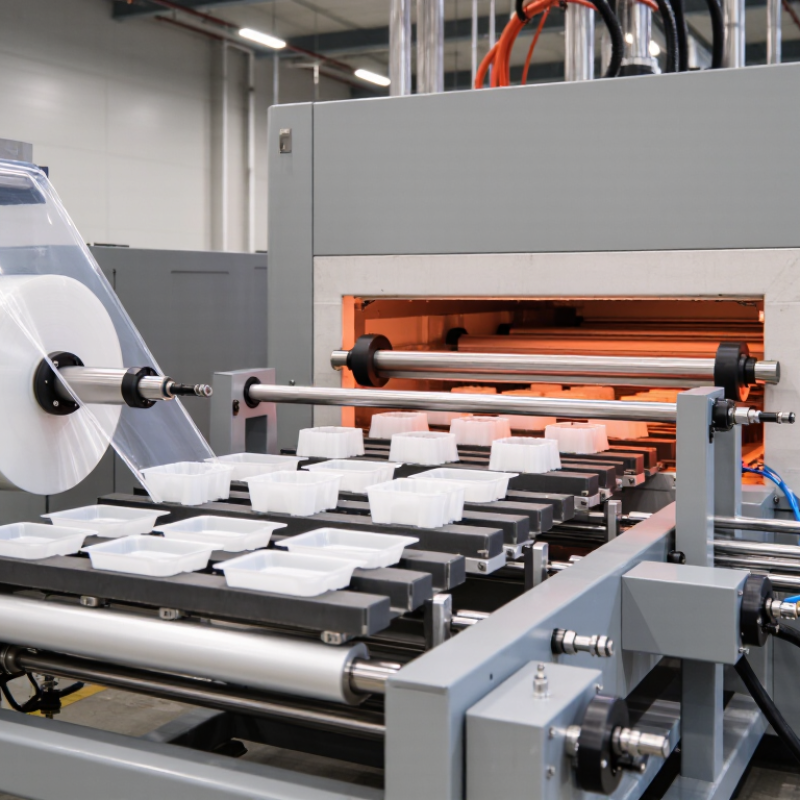
A plastic thermoforming machine heats a flat plastic sheet until it becomes soft and flexible. It then shapes the sheet over or inside a mold. Vacuum, air pressure, or mechanical force creates the final form. After cooling, a cutting station removes excess material. The result may be a food tray, medical package, appliance liner, or protective insert.
In practical production, the machine includes heaters, a sheet-loading system, forming tools, cooling controls, and trimming equipment. A reliable model keeps temperature even across the sheet. Uneven heat can cause thin corners, wrinkles, or weak edges. Operators should check cycle time, mold-change access, sheet thickness range, and energy use. Servo-driven movement may improve repeatability, but it can increase maintenance skills and purchase cost. That trade-off matters.
The best machine in China depends on the product, material, output, and available workshop space. PET, PP, PS, and ABS do not process identically. A machine designed for thick industrial panels may perform poorly with thin packaging film. Ask for sample trials using your actual sheet and mold. Inspect the formed parts, not only the sales data. In my experience, small details matter: stable clamping, clear controls, accessible heaters, and practical operator training. No machine is perfect. A fast cycle can still produce waste when cooling is rushed or trimming drifts. Good technical support, spare-part availability, safety documentation, and verified testing often matter more than a low initial price.
| Machine Type | Typical Forming Method | Common Sheet Materials | Typical Sheet Thickness | Typical Production Speed | Best-Suited Applications | Main Advantages | Important Limitations |
|---|---|---|---|---|---|---|---|
| Vacuum Thermoforming Machine | Heated sheet formed over a mold using vacuum pressure | ABS, HIPS, PET, PP, PVC, PLA and other thermoplastics | Approximately 0.2–6 mm | About 5–30 cycles per minute, depending on part size and process | Trays, disposable packaging, covers, liners and displays | Lower tooling cost, simple operation and broad material compatibility | Lower detail reproduction and dimensional accuracy than pressure forming |
| Pressure Thermoforming Machine | Vacuum forming combined with compressed air applied above the sheet | ABS, HIPS, PET, PP, PC, PS and engineering thermoplastics | Approximately 0.3–8 mm | About 3–20 cycles per minute, depending on geometry and cooling time | Automotive interiors, appliance parts, medical housings and technical covers | Improved surface detail, sharper corners and better dimensional control | Higher equipment, tooling and compressed-air requirements |
| Twin-Sheet Thermoforming Machine | Two heated sheets formed separately and joined during the cycle | HDPE, PP, ABS, HIPS and other compatible thermoplastics | Approximately 1–8 mm per sheet | About 1–8 cycles per minute, depending on product volume and weld design | Pallets, ducts, tanks, hollow containers and double-wall components | Creates hollow or double-wall parts with integrated structure | More complex tooling, alignment and process control |
| Roll-Fed Thermoforming Machine | Plastic roll stock is indexed through heating, forming, cutting and stacking stations | PET, PP, PS, HIPS, PLA and coated packaging films | Approximately 0.15–2.5 mm | About 10–45 cycles per minute, depending on mold layout and part size | Food containers, pharmaceutical packaging, cups and clamshells | High material utilization and efficient continuous production | Less suitable for very thick sheets or large, deep industrial parts |
| Sheet-Fed Thermoforming Machine | Pre-cut sheets are automatically loaded, heated, formed and trimmed | ABS, HIPS, PMMA, PC, PP, HDPE and multilayer sheets | Approximately 1–12 mm | About 2–15 cycles per minute, depending on sheet dimensions and part depth | Large covers, vehicle components, equipment housings and industrial trays | Handles thicker and larger sheets with flexible production changeovers | More manual material handling and potentially higher scrap than roll-fed systems |
The machine feeds a plastic sheet evenly. Heaters soften it across controlled temperature zones. Clamps hold the sheet above a mold. Vacuum pulls the plastic against the mold surface. Cooling hardens the formed part before trimming.
Vacuum removes trapped air and draws plastic tightly onto the mold. Pressure forming adds compressed air for sharper details. Proper venting reduces wrinkles, webbing, and thin corners. Small vents matter.
Uneven heating can create weak corners, wrinkles, or inconsistent wall thickness. Infrared or ceramic heaters soften the sheet gradually. Sensors monitor temperature before forming. Heat changes everything.
Measure sheet thickness, forming depth, mold size, and hourly demand. A thin tray machine may struggle with thick housing parts. Confirm the forming area carefully. Bigger is not always better.
Use your actual plastic material and production mold. Check heating uniformity, corner detail, trimming accuracy, and cycle stability. Inspect wall thickness at several points. One successful sample is not enough.
Compare cycle time, energy consumption, forming area, heating zones, and maintenance access. Review the vacuum system, cooling method, and control interface. Fast output can hide unstable quality.
Check floor space, electrical supply, compressed air, and vacuum capacity. Installation may also require suitable ventilation and operator access. Measure the available area with a tape. Small oversights become costly.
Request electrical diagrams, maintenance schedules, spare-parts information, and installation requirements. Ask about warranty coverage and technical response times. Test the machine continuously for several hours. Catalog figures often assume ideal conditions.
Include tooling, shipping, installation, training, energy use, and future maintenance. The lowest quotation may create higher rejection costs later. A slower machine might produce steadier parts. I would still question every promised number.
Choosing the best Plastic Thermoforming Machine in China requires a clear understanding of how thermoforming works and which machine type suits your production goals. These machines heat plastic sheets until they become flexible, then shape them over or into molds using vacuum, pressure, or mechanical force. Available options may include vacuum forming, pressure forming, single-station, roll-fed, and fully automatic systems, each designed for different materials, product sizes, output levels, and automation requirements.
To evaluate machine quality, consider forming accuracy, heating consistency, cycle speed, energy efficiency, mold compatibility, control systems, safety features, maintenance requirements, and after-sales technical support. The ideal machine should match your plastic material, product design, production volume, available workspace, and budget. By comparing performance data, construction quality, customization options, and long-term operating costs, buyers can select a reliable Chinese thermoforming solution that delivers stable results and supports future production growth.

 Yicai Machinery