Choosing the right Film Packaging Machine is no longer only a price comparison. Global buyers must examine speed, sealing accuracy, film compatibility, energy use, maintenance access, and local technical support. A machine may run beautifully during a factory trial, then struggle with humidity, unstable film rolls, or limited operator training.
Industry data shows why this decision matters. Smithers’ The Future of Packaging Films to 2028 identifies continued growth in flexible packaging, supported by convenience, lightweight materials, and improved product protection. Grand View Research also reports steady expansion in the global flexible packaging market through 2030. Meanwhile, PMMI’s 2024 State of the Industry report recorded strong packaging machinery demand in North America, despite economic uncertainty. These figures are useful. They are not a complete buying strategy.
Pierre Pienaar, a packaging technology specialist and former World Packaging Organisation president, has stated, “Packaging is the silent salesperson.” A Film Packaging Machine must therefore protect the product and support consistent presentation. Seal quality, neat film alignment, readable coding, and stable output all influence the final customer experience.
This guide reviews seven machines for international purchasing teams. The selection considers real production details, including changeover time, touchscreen controls, spare-part availability, and safety design. Some rankings remain debatable. A high-speed machine is not automatically the best choice for every factory. A smaller operation may gain more from reliable service and simple adjustments than from maximum output.
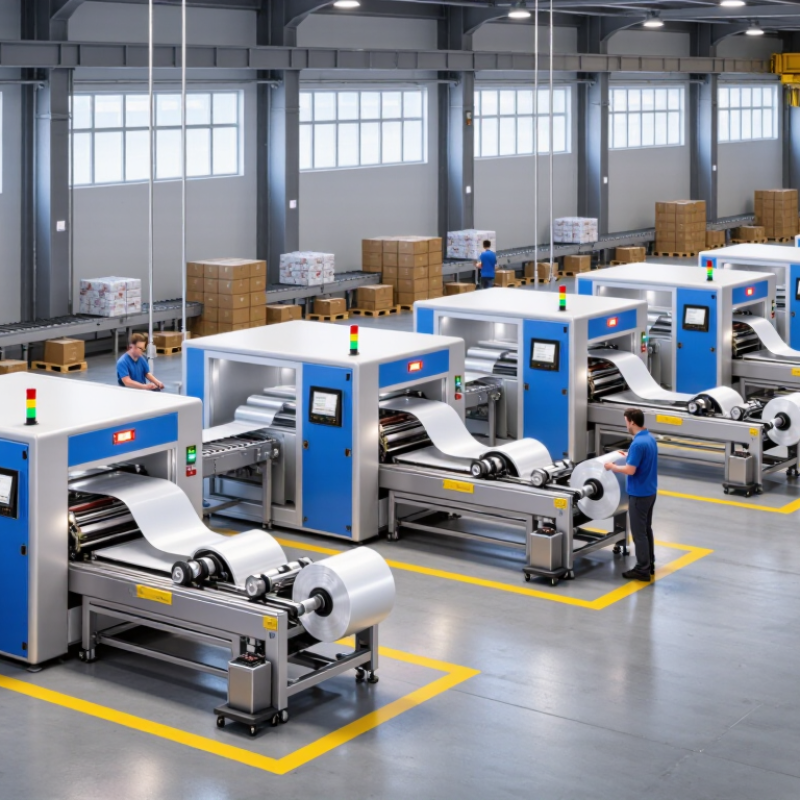
Global buyers can classify seven film packaging options by product shape, speed, and sealing method. VFFS machines form bags vertically from a film roll. They suit snacks, powders, grains, and irregular products. HFFS machines seal horizontally and handle pouches, sachets, and small cartons. Flow wrappers create tight pillow packs around biscuits, bars, and medical-safe consumer goods. Shrink wrappers use heated film for multipacks and protective bundles. Vacuum machines remove air before sealing. Skin packaging holds a product against a shaped film tray. Thermoformers heat film, form cavities, then seal lidding film.
The categories overlap.
Smithers’ The Future of Flexible Packaging to 2028 forecasts the global flexible packaging market will approach 300 billion US dollars by 2028. That growth increases pressure for efficient film use and reliable sealing. PMMI’s 2024 State of the Industry report also identifies labor shortages and automation as major equipment-buying concerns.
Therefore, servo control, quick changeovers, and remote diagnostics deserve practical attention. They are not just brochure language.
VFFS generally offers strong output with compact footprints. HFFS gives better control for delicate, flat products. Flow wrappers need accurate product spacing. Shrink systems require careful temperature control to prevent distortion.
Vacuum, skin, and thermoforming machines demand suitable barrier films and stable sealing surfaces. I would test real film rolls before approving any machine. Laboratory samples can mislead. Humidity, dust, and inconsistent product sizes often expose weaknesses during factory trials. Energy use also needs measurement, because heating tunnels and idle compressors quietly raise operating costs.
7 Best Film Packaging Machines for Global Buyers
For global buyers, the best film packaging machine depends on measurable production needs. The seven common choices include horizontal flow wrappers, vertical form-fill-seal machines, shrink wrappers, L-sealers, tray sealers, sachet machines, and multipack wrappers. Compare packs per minute, not only the advertised maximum. A practical line may run at 60–180 packs per minute, depending on product shape, film type, and operator skill.
Film width affects product flexibility and material cost. Many machines accept widths from 250 to 800 millimeters, while specialized models handle wider reels. Check the seal range carefully. A 2–8 millimeter seal may suit light pouches, but thicker laminate often needs stronger temperature control and pressure. Wider seals can improve package strength, yet they may increase film use. Small details matter.
Changeover time is often overlooked. A machine requiring 45 minutes between products can lose significant output during short production runs. Tool-free guides, recipe storage, and adjustable forming collars can reduce this delay. In plant trials, a 10-minute changeover felt more valuable than a higher peak speed. Still, advertised figures can be optimistic. Real capacity drops with irregular products, cautious feeding, or film wrinkles. Buyers should request a timed test using their own product, film width, and sealing temperature. That evidence is more reliable than a polished brochure.
Comparison of typical operating metrics: packs per minute, maximum film width, seal width, and changeover time.
The figures represent rounded, typical commercial operating values for commonly used machine formats. Actual performance varies with product type, pack size, film structure, lane count, filling system, and automation level. Lower changeover time generally indicates greater flexibility for mixed-product production.
7 Best Film Packaging Machines for Global Buyers
Global buyers should test film before selecting among seven common machine types: vertical form-fill-seal, horizontal form-fill-seal, flow wrapping, sachet, stick-pack, vacuum, and shrink-bundling systems. Smithers’ 2024 flexible packaging report forecasts the global market will exceed $300 billion by 2028. That growth increases pressure to run thinner, recycled, and multilayer films without unstable feeding or weak seals.
ASTM D882 measures tensile strength and elongation. It shows whether a film can survive pulling, folding, and forming. ASTM D1894 measures the coefficient of friction. High friction may cause film tracking errors, while low friction can create slipping and poor registration. Seal-strength testing, commonly performed under ASTM F88/F88M, checks the force needed to open a sealed pouch. Test samples from the actual machine, not only from the film supplier.
Small differences matter. A film may pass D882 but still wrinkle near the forming shoulder. Another may show acceptable friction yet seal unevenly after long production runs. Packaging Machinery Manufacturers Institute reports that labor availability and automation remain major machinery concerns. Therefore, buyers should compare sealing temperature, dwell time, jaw pressure, film tension, and line speed during trials.
Do not trust one test result.
Humidity, dust, ink coverage, and storage time can change performance. That is the uncomfortable part. Laboratory data guides selection, but production evidence should decide it. Keep failed samples, record machine settings, and repeat tests after conditioning. This disciplined process often reveals compatibility problems before they become expensive equipment problems.
| No. | Machine Type | Typical Pack Format | Common Film Structures | Typical Film Gauge | ASTM D882 Compatibility Check | ASTM D1894 Compatibility Check | Seal-Strength Qualification | Typical Speed Range | Best Application Fit |
|---|---|---|---|---|---|---|---|---|---|
| 1 | Vertical Form-Fill-Seal Machine | Pillow bags, gusseted bags, block-bottom bags | PE, PP, PET/PE, BOPP/CPP, metallized PET/PE laminates | 40–150 µm | Measure tensile strength and elongation in both machine and transverse directions; confirm the film does not stretch excessively during forming. | A controlled dynamic COF is important for forming-collar movement and registration. A practical starting screen is approximately 0.20–0.40, subject to machine design. | Check hot-tack behavior, seal-window width, and final seal strength using ASTM F88/F88M or an agreed equivalent. Typical flexible-packaging screening values may be about 1–4 N/15 mm. | 30–120 bags/min | Powders, granules, snacks, pet food, coffee, and household products |
| 2 | Horizontal Form-Fill-Seal Machine | Three-side-seal and pillow-style packs | BOPP/CPP, PET/PE, PET/CPP, paper/PE, recyclable PE-based films | 35–120 µm | Verify MD/TD tensile and elongation so the web can withstand longitudinal transport, folding, and transverse cutting without tearing. | Check static and kinetic COF for smooth web transport. Excessively low COF can cause tracking problems; excessively high COF can increase drag and registration error. | Evaluate seal strength after dwell-time and temperature trials. Inspect for channel leaks, contamination sensitivity, seal-through-film failure, and consistent peel or burst behavior. | 40–250 packs/min | Bars, biscuits, bakery items, medical disposables, and individually wrapped products |
| 3 | Premade Pouch Filling and Sealing Machine | Stand-up pouches, flat pouches, zipper pouches, spouted pouches | PET/PE, PET/CPP, PA/PE, PET/AL/PE, high-barrier recyclable laminates | 70–180 µm | Confirm adequate tensile strength, tear resistance, and dimensional stability for pouch opening, filling, handling, and transfer. | Measure pouch-to-pouch and pouch-to-metal contact behavior where relevant. COF variation can affect pouch separation, opening, and transfer stability. | Test top seals, corner seals, zipper areas, spout interfaces, and contaminated seals. Use ASTM F88/F88M for seal-strength measurement and a leak test for package integrity. | 8–60 pouches/min | Sauces, liquid detergents, frozen food, coffee, pet treats, and stand-up retail packaging |
| 4 | Sachet and Stick-Pack Machine | Four-side-seal sachets and narrow stick packs | PET/PE, PET/CPP, paper/PE, metallized PET/PE, foil laminates | 45–110 µm | Check tensile strength, elongation, and tear behavior because narrow webs are sensitive to edge damage and tension variation. | Stable COF is essential for multi-lane web tracking. Screen the film in both directions and monitor changes caused by ink, varnish, or surface treatment. | Use ASTM F88/F88M to compare seal strength across lanes. Also assess hot tack, seal contamination tolerance, and seal creep under product load. | 300–1,500 packs/min, depending on lane count | Sugar, seasonings, pharmaceuticals, instant beverages, cosmetics, and single-use portions |
| 5 | Thermoform-Fill-Seal Machine | Rigid or semi-rigid formed trays with lidding film | Forming webs based on PET, PP, PS, or PA/PE; lidding films based on PET/PE, PA/PE, or peelable sealants | Forming web: 150–900 µm; lidding film: 40–100 µm | Test the lidding film and forming web separately in MD/TD. Confirm dimensional stability, puncture resistance, and forming performance at the selected temperature. | Evaluate film handling, release from forming tools, and web tracking. COF should remain stable after heating and cooling cycles. | Measure peelable or hermetic seal strength with ASTM F88/F88M. Check seal uniformity around corners, flange transitions, and product-contaminated areas. | 8–40 cycles/min | Meat, cheese, ready meals, medical trays, and modified-atmosphere packaging |
| 6 | Vacuum Chamber or Vacuum-Skin Packaging Machine | Vacuum pouches, skin packs, and shrinkable barrier packs | PA/PE, PA/EVOH/PE, PET/PE, shrink barrier films, peelable multilayer structures | 70–200 µm | Confirm puncture resistance, elongation, and tensile performance after vacuum and shrink exposure; test both principal directions. | Check film friction during loading and evacuation. Excessive COF may hinder film conformity, while unstable COF can cause misalignment during closing. | Perform ASTM F88/F88M seal-strength tests together with vacuum-decay, bubble-emission, or another validated leak test. Assess seal performance after refrigeration or thermal cycling. | 3–20 cycles/min | Fresh meat, seafood, cheese, medical products, and products requiring extended shelf life |
| 7 | Flow-Wrapping Machine | Pillow packs with longitudinal and end seals | BOPP/CPP, BOPP/PE, PET/PE, paper-based heat-sealable laminates, recyclable polyolefin films | 25–100 µm | Check MD/TD tensile strength, elongation, tear resistance, and stiffness for reliable feeding around the forming box and sealing jaws. | Dynamic COF is a key screening property for film travel and product spacing. Verify consistent values across the roll width and between production lots. | Evaluate longitudinal and transverse seals using ASTM F88/F88M or an agreed internal method. Include seal-through-product, hot tack, and jaw-pressure trials. | 60–500 packs/min | Confectionery, bakery goods, bars, produce, frozen products, and multipack retail items |
Selecting a film packaging machine requires more than checking speed and output. For sterile medical packaging, ISO 11607 focuses on forming, sealing, and maintaining the sterile barrier. A reliable machine should control sealing temperature, pressure, and dwell time consistently. Operators should record these values during installation and routine production. Small changes matter.
FDA 21 CFR requirements may affect materials, processing controls, records, and product safety in the United States. Confirm whether the film, ink, adhesive, and seal process suit the intended application. Ask for traceability data, validation support, and clear maintenance procedures. A polished brochure is not enough. Request real test records.
For European markets, CE conformity depends on the complete machine and its applicable directives. UKCA may apply when equipment enters the Great Britain market, subject to current rules. Check electrical safety, machinery risks, electromagnetic compatibility, and technical documentation. The machine should support seal-strength testing, leak checks, and repeatable sampling.
A perfect seal on one shift proves little. Humidity, film batches, and operator habits can change results. This is where many evaluations become too optimistic. Run trials with your actual film and production conditions. Review failed seals, not only successful samples. An experienced supplier should explain limitations clearly and help build a practical validation plan.
The best film packaging machine is not always the fastest. Measure OEE across real shifts, not showroom demonstrations. ISO 22400 defines OEE through availability, performance, and quality. Ask suppliers for each component separately. A machine running quickly but stopping for film changes may look impressive. It may still lose production hours.
Energy per pack deserves equal attention. Record kWh per 1,000 finished packs, including heaters, conveyors, sealing systems, and compressed air. The International Energy Agency consistently identifies manufacturing efficiency as a major emissions-reduction opportunity. PMMI’s 2024 State of the Industry report also highlights sustainability and labor pressure as important packaging investment drivers.
Small differences matter at global volume. A saving of 0.02 kWh per 1,000 packs sounds minor. Over millions of packs, it is not.
Lifecycle cost includes film waste, spare parts, training, maintenance labor, and downtime. Request a five-year cost model with local electricity and labor rates. Local service is practical risk control, not decoration. Check technician response times, critical-parts inventory, remote diagnostics, and language support. ISO 50001 principles can help structure energy monitoring, but they do not replace factory measurements. Be skeptical of perfect OEE claims. Your products, operators, and film conditions will differ. Pilot testing may reveal an uncomfortable truth: the cheaper machine can become the expensive one.
Vertical systems suit powders, grains, snacks, and irregular products. Horizontal systems suit pouches, sachets, flat goods, and small cartons. Product shape matters more than machine appearance.
Flow wrappers create tight pillow packs around biscuits, bars, and similar items. Accurate spacing is essential. Misaligned products can cause empty seals or damaged edges.
Shrink systems suit multipacks and protective bundles. Vacuum machines remove air before sealing. Skin systems hold products against shaped trays, while thermoformers create cavities before applying lidding film.
Film may pass laboratory tests but wrinkle during forming. Test real rolls on the proposed machine. Humidity, dust, ink coverage, and storage time can change results.
Tensile strength shows whether film survives pulling and folding. Friction affects tracking and registration. Seal-strength testing checks how much force opens a finished pouch.
Record sealing temperature, dwell time, jaw pressure, film tension, and line speed. Keep failed samples. They often reveal problems that successful samples hide.
No. Measure availability, performance, and quality across real shifts. A fast machine that stops during film changes may lose more production time.
Measure kilowatt-hours per 1,000 finished packs. Include heaters, conveyors, sealing equipment, and compressed air. Small differences become significant across millions of packs.
Include film waste, spare parts, training, maintenance labor, and downtime. Request a five-year estimate using local electricity and labor costs. The cheaper machine may become expensive.
Check response times, spare-parts inventory, remote diagnostics, and language support. Service is practical risk control. I would not rely on perfect sales promises.
Choosing the right Film Packaging Machine requires more than comparing purchase prices. This guide examines seven common equipment types, including vertical form-fill-seal, horizontal form-fill-seal, flow wrapping, shrink wrapping, and other practical configurations. Buyers can compare packs per minute, film width, sealing range, and changeover time to match production targets, product dimensions, and packaging flexibility. These metrics help identify whether a machine can maintain reliable output while adapting efficiently to different formats.
Material compatibility and international readiness are equally important. Evaluation should include film performance using methods such as ASTM D882, ASTM D1894, and seal-strength testing, together with applicable requirements such as ISO 11607, FDA 21 CFR, CE, and UKCA. Finally, consider overall equipment effectiveness, energy consumption per pack, maintenance needs, lifecycle cost, training, spare parts, and local technical service. A balanced decision based on performance, compliance, efficiency, and long-term support can reduce operational risk and deliver dependable value for global packaging operations.

Yicai Machinery